
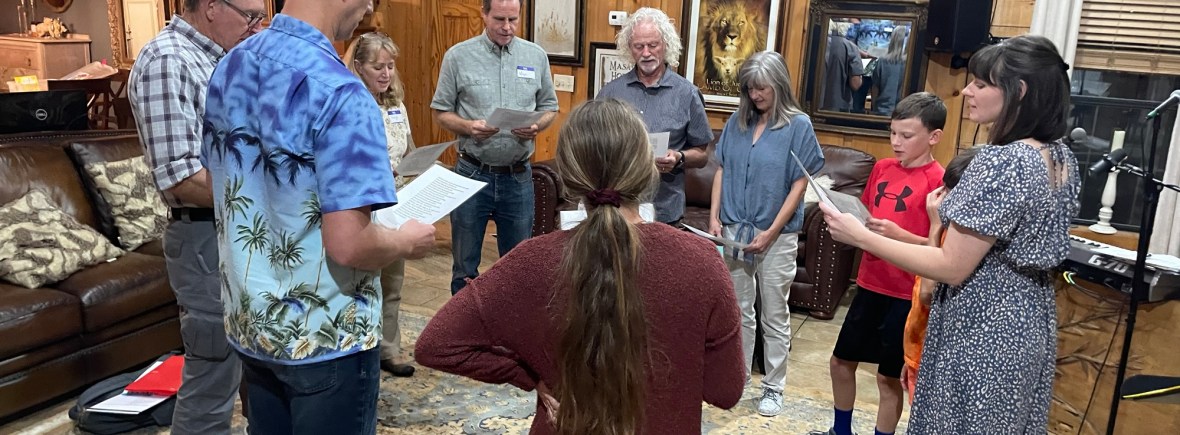
Experience the healing power of Psalmic breathing—where communal Psalm reading welcomes the Holy Spirit, calms the nervous system, rewires the brain, activates the vagus nerve, and unites the Body of Christ.
I’ve seen it time and time again—
A combat veteran trembling with pain. A mother weighed down by anxiety. A child unsure how to breathe through their grief.
But then, something sacred happens. We open our Bibles. We turn to the Psalms. We begin to breathe. We begin to speak.
And healing comes.
The room exhales. Tears fall. Peace enters. The Spirit moves.
This is Psalmic Breathing—a holy, biblical, and physiological invitation into God’s healing presence.
What Is Psalmic Breathing?
Psalmic breathing is the Spirit-led practice of pairing deep, rhythmic breaths with reading aloud of the Psalms.
It’s not mystical. It’s not new age.
It’s ancient, sacred, and grounded in both scripture and science. In fact, the biblical pattern of breath, speech, and communal worship has been part of God’s design from the beginning.
The Hebrew name of God—YHWH—was traditionally considered too holy to pronounce, but many Jewish scholars have long taught that the name itself sounds like breath: “Yah” on the inhale and “Weh” on the exhale. This reinforces the idea that breath itself is a prayer—an ever-present reminder of God’s nearness and name.
The Psalms were not meant to be read silently but sung, chanted, or spoken aloud in community. In the Temple, Levitical choirs sang them daily (1 Chronicles 15–16). After the exile, they were read responsively in synagogues—line by line, breath by breath.
The Psalms of Ascent (Psalms 120–134) were recited or sung by worshipers as they ascended the hill to Jerusalem for festivals. These were often spoken aloud in group rhythm, matching breath and step in a sacred pilgrimage.
Celtic Christians embraced this rhythmic, breath-focused worship. Their liturgies blended nature, scripture, and breath, seeing no divide between body and spirit. They chanted Psalms along rugged coastlines and in candle-lit abbeys, syncing voice with wind and waves.
Early church fathers like Athanasius called the Psalms a “mirror of the soul” and encouraged believers to read them aloud as spiritual medicine. He wrote that in the Psalms, “you find depicted all the movements of your soul, all its changes, its ups and downs.”
So when we practice Psalmic breathing today—when we inhale truth and exhale fear—we’re not creating something new. We’re stepping into an ancient stream of Spirit-led worship and healing.
When practiced in community, Psalmic breathing becomes even more powerful:
—Inhale together
—Speak one line of the Psalm aloud
—Exhale together
Repeat, slowly, intentionally, reverently.
Before long, everyone is breathing in sync. The presence of God settles like a weighted blanket. Tight jaws unclench. Spines ease from rigid posture. Hands once clenched in fear now rest open in surrender. Tears fall. Trauma lifts.
Psalmic breathing is both a prayerful encounter with the Holy Spirit and a powerful tool for regulating the nervous system.
What’s Happening in the Body?
Let’s explore the threefold wonder of Psalmic breathing: vocal stimulation, deep breathing, and communal belonging. When we breathe and read the Psalms aloud together, heaven meets biology. God’s Word calms the soul, syncs our hearts, and heals what trauma tried to shatter.
1. Vocalization Stimulates the Vagus Nerve
The vagus nerve is your body’s superhighway of calm. It runs from your brainstem to your abdomen, regulating your rest and digest system. When you speak aloud—especially scripture—you activate this nerve gently and naturally.
—Vocal cords vibrate
—Brain calms
—Stress hormones lower
—Peace flows in
Reading scripture aloud isn’t just spiritual—it’s biological medicine. The ancients knew this before science did.
2. Deep, Rhythmic Breathing Regulates the Nervous System
Psalmic breathing slows the breath. Inhale for 4 counts. Exhale for 6 (or more). That longer exhale is gold—it’s what triggers the parasympathetic nervous system, calming anxiety and stabilizing emotions.
This improves:
—Heart rate
—Emotional regulation
—Resilience to trauma
—Immune function
From the very beginning, God has used breath to bring life.
- Genesis 2:7 – “Then the LORD God formed man from the dust of the ground and breathed into his nostrils the breath of life.”
- Ezekiel 37 – The prophet speaks to the dry bones, and breath enters them—they rise, alive and restored.
- John 20:22 – Jesus breathes on His disciples and says, “Receive the Holy Spirit.”
- Acts 2 – The rushing wind of the Spirit fills the upper room. The breath of God fills their hearts.
Beloved, this is not poetic symbolism—it’s Kingdom reality. The breath of God heals what trauma has silenced. It revives what fear has numbed. Psalmic breathing reconnects us to the divine breath of life.
3. Community Heals the Soul
Trauma disconnects and shame isolates, but community brings safety. When we gather and breathe together, we experience co-regulation—the nervous system’s ability to stabilize through connection. You were never meant to heal alone. God created body, soul, and spirit to thrive in belonging.
Even in Scripture, we see this truth:
- When Jesus raised Lazarus, He said to the community: “Take off the grave clothes and let him go” (John 11:44). Healing came through others.
We do the same when we read Psalms together—gently helping one another remove the grave clothes of trauma, fear, and pain.
A Legacy of Psalmic Worship
This isn’t new. Psalmic breathing revives a rhythm that stretches back over 3,000 years!
Ancient Israel
—Psalms were sung by Levitical choirs in temple worship (1 Chronicles 15–16).
—Jews chanted Psalms in daily synagogue prayer.
—Pilgrims sang Psalms of Ascent as they climbed toward Jerusalem (Psalms 120–134).
Early Church
—Believers read and sang Psalms aloud in house churches.
—The Didache, an early Christian document, encouraged regular Psalm recitation.
—Church fathers like Athanasius and Augustine praised the Psalms as essential for soul formation.
Desert Fathers & Mothers
—Monastic communities structured their entire day around Psalm recitation.
—Chanting became breath-based worship, a practice of uniting breath, voice, and prayer.
Celtic Christianity
—Irish and Scottish monks practiced breath-prayers and Psalm chanting during daily rhythms of work and worship.
—The Psalms became their spiritual anchor in windswept solitude.
Medieval to Modern Church
—Gregorian chants preserved the Psalms through centuries of liturgical singing.
—Reformers translated Psalms into vernacular songs for everyday believers.
—Even today, both liturgical and charismatic churches use the Psalms in breath-like rhythm—whether through song, silence, or spoken word.
Psalmic breathing is more than a tool. It’s a sacred inheritance. It’s how the people of God have healed, centered, and communed with Him for millennia.
How to Practice Psalmic Breathing in a Group
Here’s how to bring this into your home, small group, or trauma-healing gathering:
- Choose a Psalm: Start with something familiar: Psalm 23, Psalm 121, or Psalm 46.
- Gather your people: Family, friends, Bible study buddies, military or first responder groups, homeschoolers, or a prayer team. All ages can (and should) participate.
- Practice deep breathing: Inhale for 4. Exhale for 6. Do this silently for one minute to settle your body and spirit.
- Read together, line by line: Inhale. Speak one line aloud. Fully exhale. Repeat until you finish the Psalm. Let the Word flow like breath.
- Sit in worshipful silence afterward: Let the peace settle in. Listen for the whisper of the Spirit.
- Reflect and share: What did you feel? What shifted? What did God reveal?
The Science Supports It. The Spirit Confirms It.
—The vagus nerve responds.
—The nervous system stabilizes.
—Heart rate variability improves.
—The soul rests.
—The Holy Spirit ministers.
Psalmic breathing invites you to speak truth, breathe grace, and return to peace.
This is holy trauma healing.
This is biblical meditation.
This is wholeness in Christ.
Final Word
If you’re weary, wounded, or waiting for breakthrough…
If your body won’t settle and your mind keeps spinning…
If you’re ready to reclaim peace in the presence of God…
Then breathe.
—Open the Psalms.
—Inhale the truth.
—Speak it aloud.
—Exhale the fear.
Let your nervous system align with Heaven. Let your voice join the saints and angels. Let your breath become a sanctuary. Freedom is your birthright, and victory is your portion.
Let it begin with your next breath.
Let me walk you through biblical trauma healing, Psalmic breathing, and breath prayers.
These additional biblical practices also balance the nervous system, rewire the brain, and tone the vagal nerve: singing praise and worship to God, breath prayers, speaking blessings out loud, and prayer walks in nature.
Notes & Research:
American Psychological Association. Clinical Practice Guideline for the Treatment of Posttraumatic Stress Disorder (PTSD) in Adults. APA, 2017.
Craighead, W. Edward, and Charles B. Nemeroff, editors. The Corsini Encyclopedia of Psychology and Behavioral Science. 3rd ed., John Wiley & Sons, 2002.
Didache: The Teaching of the Twelve Apostles. Translated by J. B. Lightfoot, edited by Philip Schaff, Christian Classics Ethereal Library, 2004, https://www.ccel.org/ccel/schaff/anf07.ix.ii.i.html.
Fried, Robert. The Psychology and Physiology of Breathing: In Behavioral Medicine, Clinical Psychology, and Psychiatry. Springer, 1990.
Friedlander, Rebecca. Celtic Studies Program. http://www.rebeccafriedlander.com/celtic-studies-program.html.
Lehrer, Paul, and Richard Gevirtz. “Heart Rate Variability Biofeedback: How and Why Does It Work?” Frontiers in Psychology, vol. 5, 2014, article 756, https://doi.org/10.3389/fpsyg.2014.00756.
Porges, Stephen W. The Polyvagal Theory: Neurophysiological Foundations of Emotions, Attachment, Communication, and Self-Regulation. W. W. Norton & Company, 2011.
The Holy Bible, English Standard Version. Crossway, 2016.
Yahweh’s Restoration Ministry. “Breathing the Name Yahweh.” YRM.org, https://yrm.org/breathing-the-name-yahweh/.
 Robin Ludwig